

RORC activity model
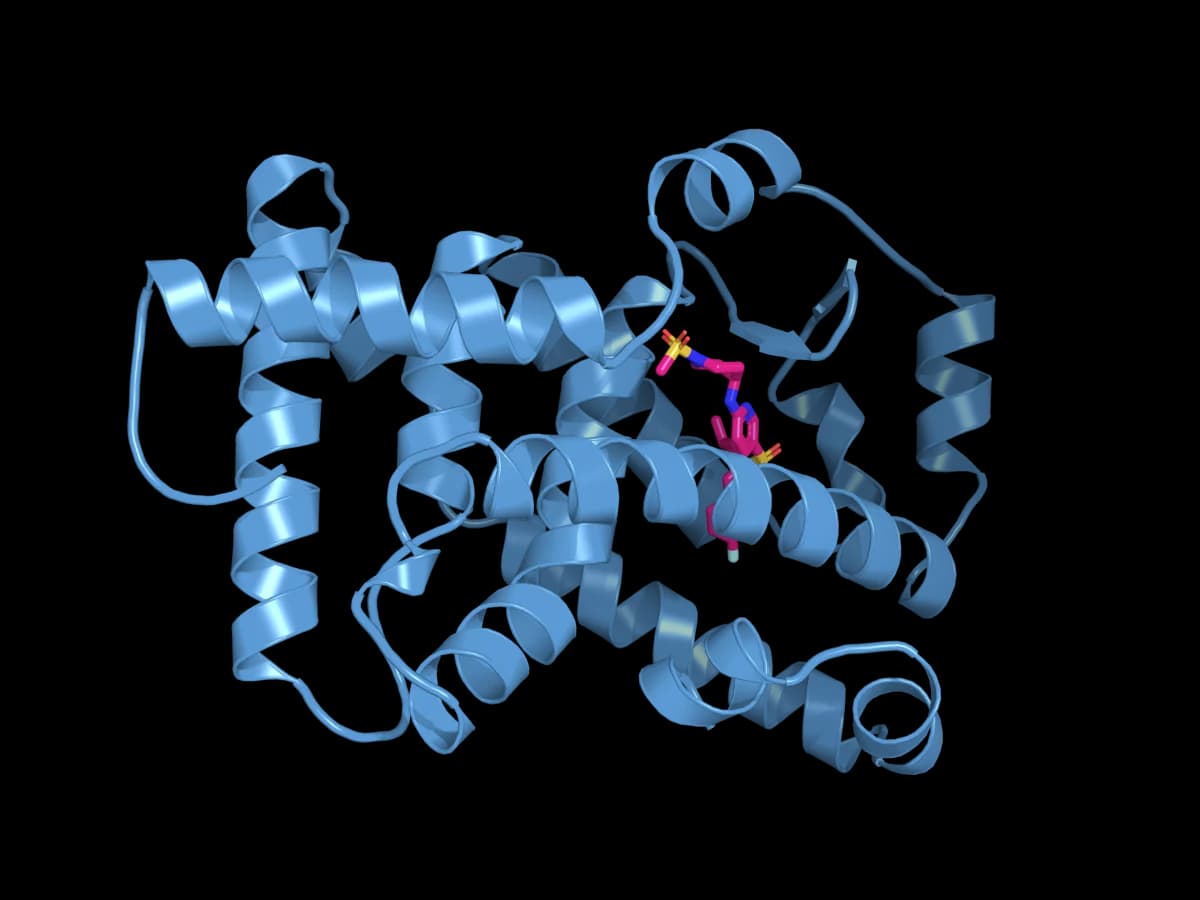
RORC (RORγt) is a nuclear receptor transcription factor that drives Th17 cells, the main source of IL-17. Inverse agonists that bind its ligand-binding domain are studied for autoimmune diseases such as psoriasis.
A model trained on measured activity data for RORC (Immunology). Give it compounds and it predicts their IC50 against RORC, so you can rank candidates by it.
Predict with this model
- UniProt
- P51449
- Reference structure
- PDB 4WLB, ligand 3QQ
- Training data
- TSAP (Boltz-2): 140 compounds, IC50TSAP (AI-QSAR): 81 compounds, IC50
- Scaffolds
- TSAP (Boltz-2): 24 scaffoldsTraining 21 · validation 9 (3 new)Largest scaffold 39%TSAP (AI-QSAR): 20 scaffoldsTraining 17 · validation 7 (3 new)Largest scaffold 40%
- Validation
- Predicted and measured values are compared on compounds held out of training.
- Cost
- From 224 credits
- Model version
- TSAP (Boltz-2): TSAP pipeline v2.2TSAP (AI-QSAR): Ridge regression on docking features
Validation results
Predicted and measured values compared on compounds held out of training. RMSE is in log units (pIC50 and similar).
TSAP (Boltz-2)
Pearson r
0.76
R² (CoD)
0.49
RMSE (log units)
0.47
Holdout compounds
34
TSAP (AI-QSAR)
Pearson r
0.73
Holdout compounds
19
How to use it
Under Predict with this model, press TSAP (Boltz-2) or TSAP (AI-QSAR). The wizard of the workflow you pressed opens with the RORC model already selected.
Upload the SMILES of the compounds to predict as a .smi, .csv or .txt file.
Check the estimated credits and time, then submit.
The result is a table of compounds ranked by predicted IC50.
Limitations
- Predictions can be less accurate for compounds whose structures differ a lot from the training data.
- Validation used only about 19 compounds, so performance on new compounds can differ from these metrics.
- Predictions do not replace experiments. Use them to decide what to synthesize and measure first.
Run your own predictions with the RORC model
Sign up and get 500 credits. No card required. You can also choose to get news about new models and workflows.