

Compound Generation
Keep the core that works and regrow the restPick the part of a compound you want to keep, and a generative model proposes a new fragment for every position you cut away. You get a ranked list of new compounds with their properties, ready to download or to feed straight into docking or activity prediction.
REINVENT4 v4.5.11, LibInvent prior · Doc updated Oct 15, 2026
- Input
- One compound, and the core to keep
- Output
- New compounds with properties
- Engine
- REINVENT4 LibInvent
- Cost
- 10 cr per job, any size
- Per job
- 100 to 50,000 compounds
When to use
- You have a compound that works and want analogues that keep its core and vary the side groups
- You want to build your own library to dock or score instead of buying a catalog one
- You want to explore what fits at one or two positions before committing to a synthesis route
The model knows nothing about your target. It proposes fragments that look like the chemistry it was trained on, not fragments that bind. Treat the output as a list of candidates and rank it with Virtual Screening or an activity model afterwards.
How it works
- 01Cut the scaffold
The atoms you keep become the scaffold. Every bond that used to leave them becomes an attachment point, written as R1 to R4, and the model fills each one.
- 02Sample fragments
The LibInvent prior reads the scaffold and proposes a set of fragments for its attachment points, over and over. It samples more than you asked for, because the next step takes some out.
- 03Clean up and filter
Structures that cannot be read are dropped, duplicates are merged, and compounds outside your molecular-weight window are removed. The survivors get their properties computed with RDKit.
- 04Rank and return
What is left is ordered by how likely the model finds it, cut to the number you asked for, and handed back as a table, a CSV, and a compound list other workflows accept.
Input formats
| Item | Accepted | Notes |
|---|---|---|
| Reference compound | A SMILES you type, or a .mol, .sdf or .mol2 upload up to 5 MB | A file holding several records contributes its first molecule only. Four example compounds are offered beside the field |
| Core | Picked by dragging a box on the drawing | At least 3 atoms, connected as one piece, whole aromatic rings, not the entire molecule, and 1 to 4 bonds leaving it |
| Elements in the core | C, N, O, S, F, Cl, Br, and their charged forms such as [nH] or [O-] | The model's vocabulary holds nothing else. Phosphorus, iodine and boron are refused, and so are stereochemistry and isotope labels |
| Number of compounds | 100 to 50,000 | This is how many the model is asked to produce. Deduplication and the weight window take some out, so you receive fewer |
| Molecular weight | A window between 0 and 1,000 Da, 200 to 500 by default | Compounds outside it are dropped after sampling. The scaffold's own weight is part of every compound, so leave room above it |
The scaffold is checked against the model's vocabulary before you are charged. A core the model cannot read is refused on screen, with the offending part named. Stereochemistry is the one case with a way forward: the wizard offers to drop it, and the compounds then come back without it.
Tutorial: regrow erlotinib's side chains
Erlotinib is the EGFR drug bound in PDB 1M17, the structure the other docs use. Its 4-anilinoquinazoline core is what binds the kinase; the two methoxyethoxy chains on the other side are the part chemists vary. We keep the core and let the model propose new chains in their place. Run example at the top of this page fills all of this in for you.
Load the reference compound
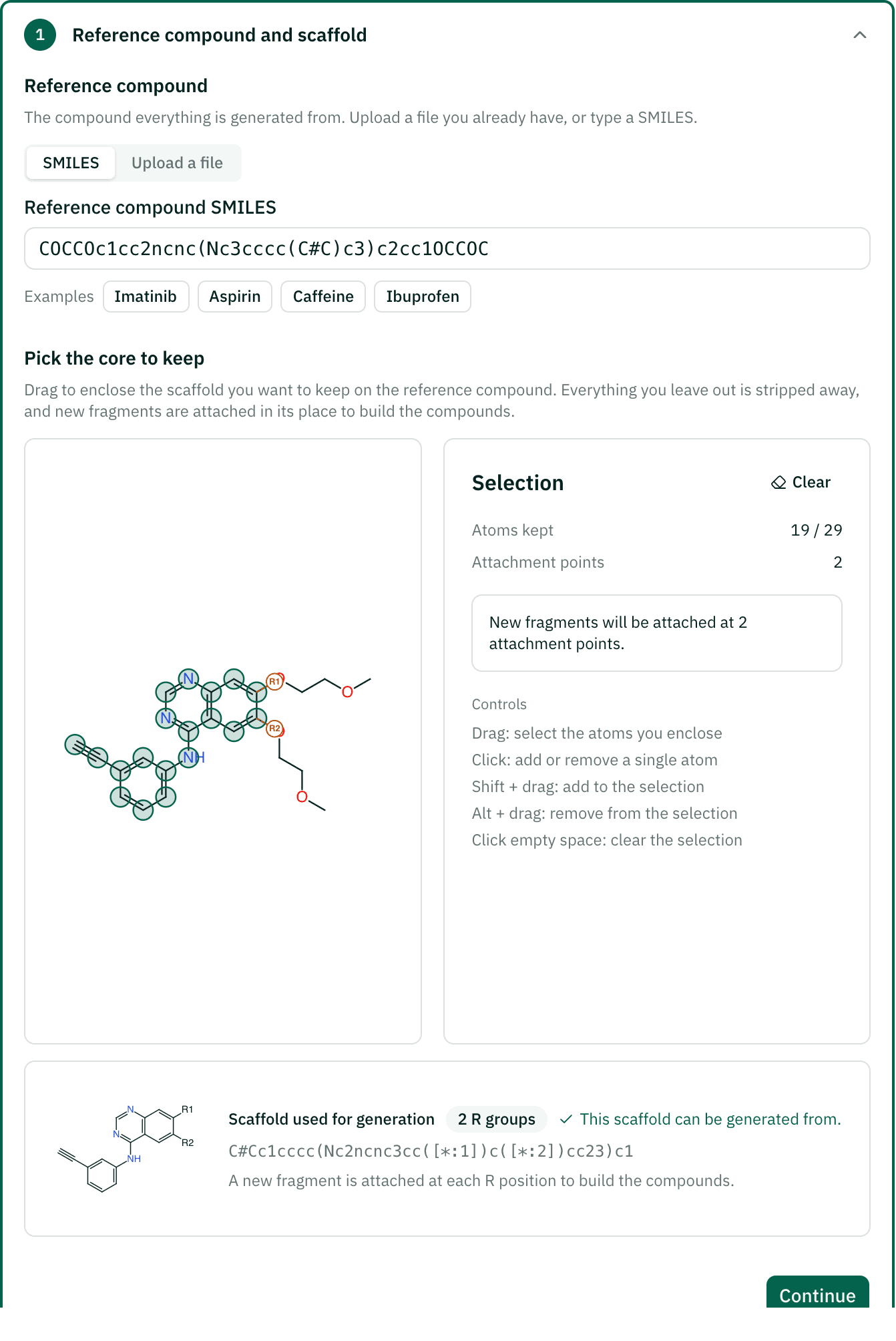
In Reference compound and scaffold, paste erlotinib's SMILES
COCCOc1cc2ncnc(Nc3cccc(C#C)c3)c2cc1OCCOC, or upload a file you already have. The molecule is drawn below the field.Pick the core to keep
Drag a box around the quinazoline and the aniline attached to it, leaving both OCCOC chains outside. The panel beside the drawing says 19 of 29 atoms kept and 2 attachment points, and the scaffold the generator will read appears underneath with R1 and R2 marked.
Set the size and the weight window
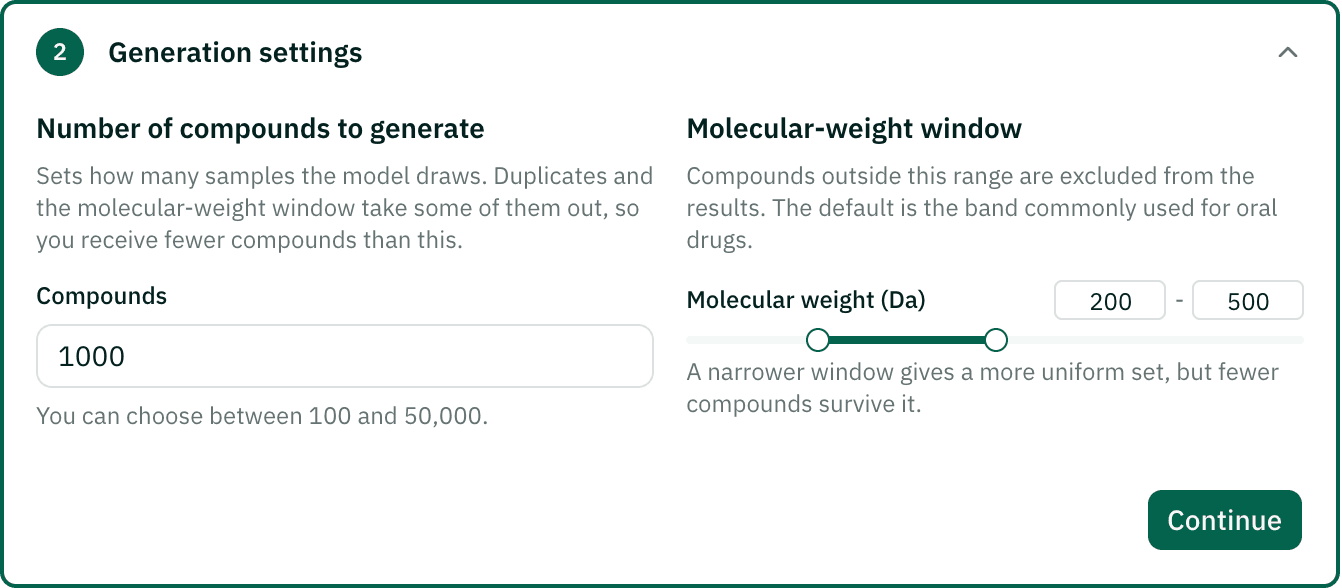
In Generation settings, leave 1,000 compounds and the 200 to 500 Da window. Erlotinib itself weighs 393 Da, so that window keeps compounds of about its size.
Check and submit
In Project Settings, name the project and submit. The cost is the same whatever size you chose, so there is nothing to trade off here.
Read the results
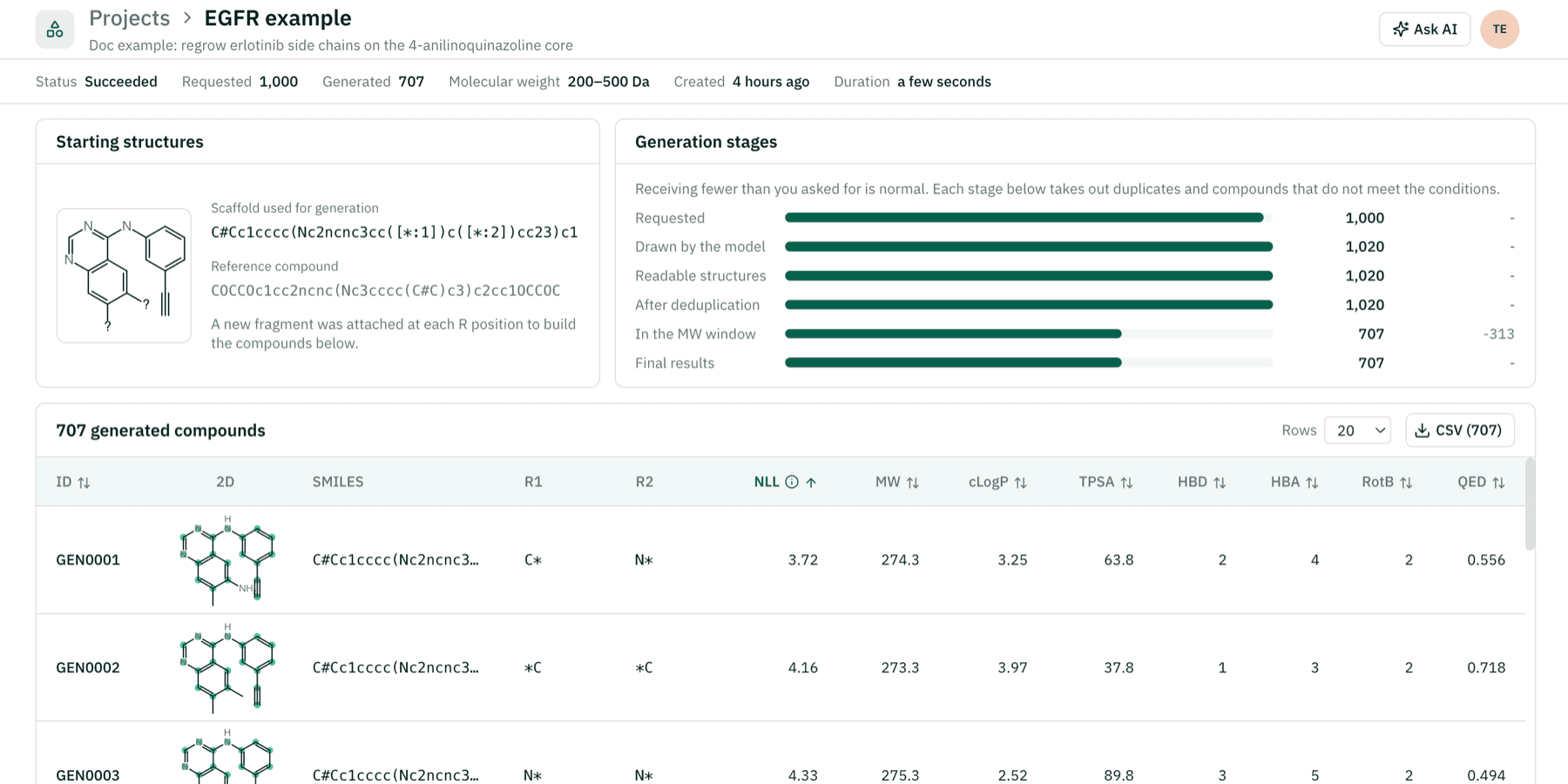
Open the project to see the compounds, the fragment at each R position, and the stage counts that explain how many survived.
Take it further
Download the compound list and screen it against your target with Virtual Screening, or score it with a target model.
Reading the results
| Column | Meaning | How to read it |
|---|---|---|
| ID | Sequence number, GEN0001 upwards | The order is the ranking below, so GEN0001 is the model's most likely compound |
| 2D | The compound drawn with the kept core highlighted | A quick check that the core survived and only the fragments changed |
| R1 to R4 | The fragment the model attached at each position | The numbering matches the R labels on the scaffold. Sort on one column to compare one position alone |
| NLL | Negative log-likelihood under the model | Lower means the model finds it more likely. It is not an activity, an affinity or a docking score |
| MW, cLogP, TPSA | Weight, lipophilicity and polar surface area | Computed with RDKit from the final structure |
| HBD, HBA, RotB | Hydrogen bond donors, acceptors and rotatable bonds | The usual drug-likeness counts |
| QED | Drug-likeness, 0 to 1 | Higher is more drug-like. One number over several properties, so read it alongside them, not instead |
Above the table, the stage counts say how many compounds the model drew, how many were readable, how many survived deduplication, and how many landed inside the weight window. Receiving fewer compounds than you asked for is normal, and those counts say which stage took them.
Example result: erlotinib core
A real job, shown read-only. Of the 1,000 compounds asked for, 1,020 were drawn and 707 landed inside the 200 to 500 Da window.
| ID | 2D | SMILES | R1 | R2 | NLL | MW | QED |
|---|---|---|---|---|---|---|---|
| GEN0001 | C#Cc1cccc(Nc2ncnc3cc(C)c(N)cc23)c1 | C* | N* | 3.72 | 274.3 | 0.556 | |
| GEN0002 | C#Cc1cccc(Nc2ncnc3cc(C)c(C)cc23)c1 | *C | *C | 4.16 | 273.3 | 0.718 | |
| GEN0003 | C#Cc1cccc(Nc2ncnc3cc(N)c(N)cc23)c1 | N* | N* | 4.33 | 275.3 | 0.494 | |
| GEN0004 | C#Cc1cccc(Nc2ncnc3cc(N)c(C)cc23)c1 | *N | *C | 5.77 | 274.3 | 0.556 | |
| GEN0005 | C#Cc1cccc(Nc2ncnc3cc(C)c(NC)cc23)c1 | *C | *NC | 6.40 | 288.4 | 0.721 |
Cost and time
A generation job costs 10 cr ($0.01 per credit) whatever size you choose. Sampling takes a little over a minute even at the upper limit, and almost all of the elapsed time goes into bringing the compute up, so the price does not follow the number of compounds. The wizard shows the quote before you submit and that is what is deducted.
The example above (1,000 compounds) took about 4 minutes from submit to result, of which 3.5 minutes was waiting for an instance, and cost 10 cr.
If the job fails, the credits come back in full. If you stop it yourself, half comes back.
Citations
If you use these results in a report or paper, please cite the methods below.
- Loeffler HH, He J, Tibo A, Janet JP, Voronov A, Mervin LH, Engkvist O. Reinvent 4: Modern AI-driven generative molecule design. J Cheminform 16, 20 (2024). doi:10.1186/s13321-024-00812-5The generative framework the job runs
- Fialková V, Zhao J, Papadopoulos K, Engkvist O, Bjerrum EJ, Kogej T, Patronov A. LibINVENT: Reaction-based generative scaffold decoration for in silico library design. J Chem Inf Model 62, 2046-2063 (2022). doi:10.1021/acs.jcim.1c00469LibInvent scaffold decoration
- RDKit contributors. RDKit: Open-source cheminformatics. Zenodo (2026). doi:10.5281/zenodo.591637Structures, properties and the scaffold cut
- Bickerton GR, Paolini GV, Besnard J, Muresan S, Hopkins AL. Quantifying the chemical beauty of drugs. Nat Chem 4, 90-98 (2012). doi:10.1038/nchem.1243QED drug-likeness
- Stamos J, Sliwkowski MX, Eigenbrot C. Structure of the epidermal growth factor receptor kinase domain alone and in complex with a 4-anilinoquinazoline inhibitor. J Biol Chem 277, 46265-46272 (2002). doi:10.1074/jbc.M207135200EGFR structure with erlotinib used in the tutorial (PDB 1M17)