

EGFR activity model
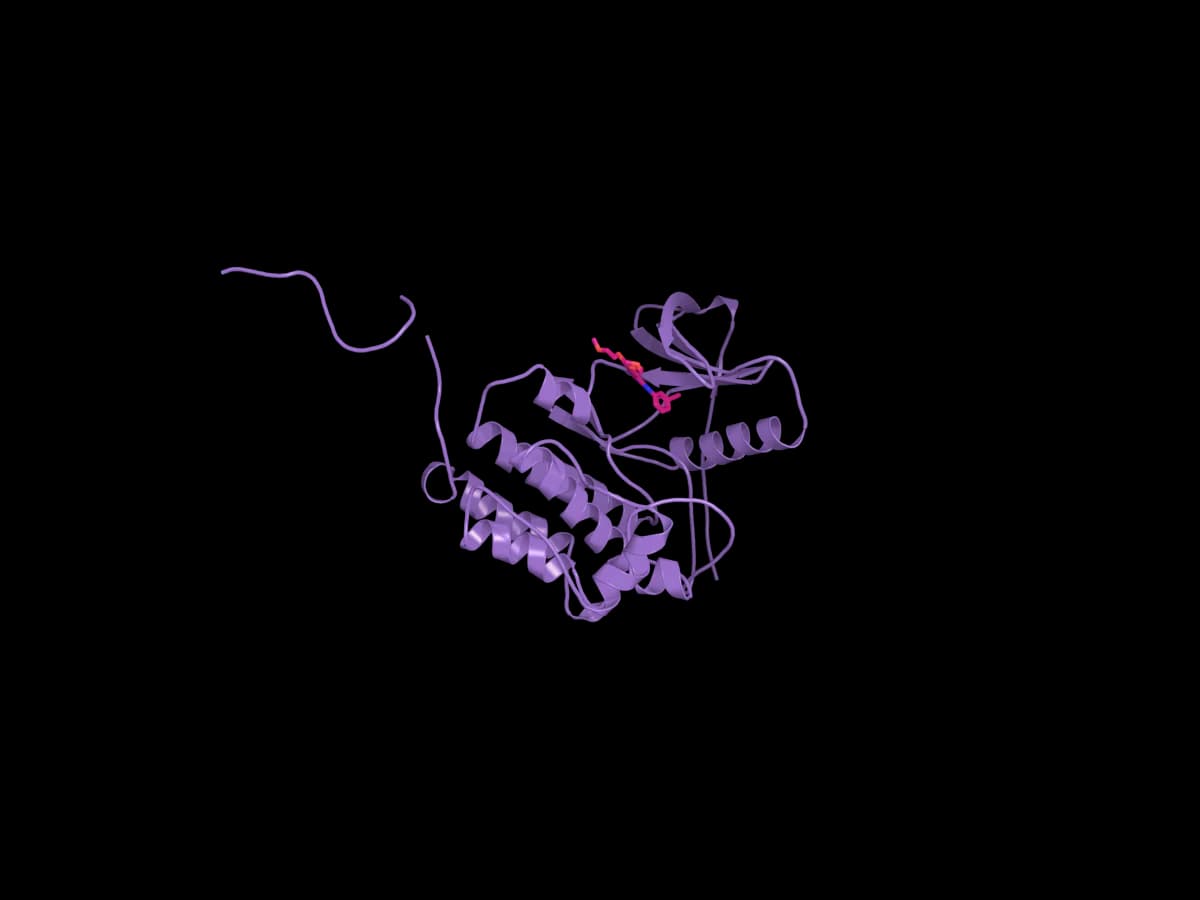
EGFR is a receptor tyrosine kinase that relays cell growth signals. Activating mutations drive non-small cell lung cancer, and drugs such as erlotinib, gefitinib and osimertinib bind the ATP site of its kinase domain.
A model trained on measured activity data for EGFR (Oncology). Give it compounds and it predicts their IC50 against EGFR, so you can rank candidates by it.
Predict with this model
- UniProt
- P00533
- Reference structure
- PDB 1M17, ligand AQ4
- Training data
- TSAP (Boltz-2): 58 compounds, IC50TSAP (AI-QSAR): 66 compounds, IC50
- Scaffolds
- TSAP (Boltz-2): 11 scaffoldsTraining 9 · validation 7 (2 new)Largest scaffold 36%TSAP (AI-QSAR): 15 scaffoldsTraining 13 · validation 8 (2 new)Largest scaffold 31%
- Validation
- Predicted and measured values are compared on compounds held out of training.
- Cost
- From 255 credits
- Model version
- TSAP (Boltz-2): TSAP pipeline v2.2TSAP (AI-QSAR): Ridge regression on docking features
Validation results
Predicted and measured values compared on compounds held out of training. RMSE is in log units (pIC50 and similar).
TSAP (Boltz-2)
Pearson r
0.90
R² (CoD)
0.69
RMSE (log units)
0.71
Holdout compounds
17
TSAP (AI-QSAR)
Pearson r
0.90
Holdout compounds
17
How to use it
Under Predict with this model, press TSAP (Boltz-2) or TSAP (AI-QSAR). The wizard of the workflow you pressed opens with the EGFR model already selected.
Upload the SMILES of the compounds to predict as a .smi, .csv or .txt file.
Check the estimated credits and time, then submit.
The result is a table of compounds ranked by predicted IC50.
Limitations
- Predictions can be less accurate for compounds whose structures differ a lot from the training data.
- Validation used only about 17 compounds, so performance on new compounds can differ from these metrics.
- Predictions do not replace experiments. Use them to decide what to synthesize and measure first.
Run your own predictions with the EGFR model
Sign up and get 500 credits. No card required. You can also choose to get news about new models and workflows.