

MAP4K1 activity model
MAP4K1 (HPK1) is a serine/threonine kinase that dampens T-cell receptor signaling. Blocking it strengthens T-cell responses, which makes it an immuno-oncology target.
A model trained on measured activity data for MAP4K1 (Immuno-oncology). Give it compounds and it predicts their Ki against MAP4K1, so you can rank candidates by it.
Predict with this model
- UniProt
- Q92918
- Reference structure
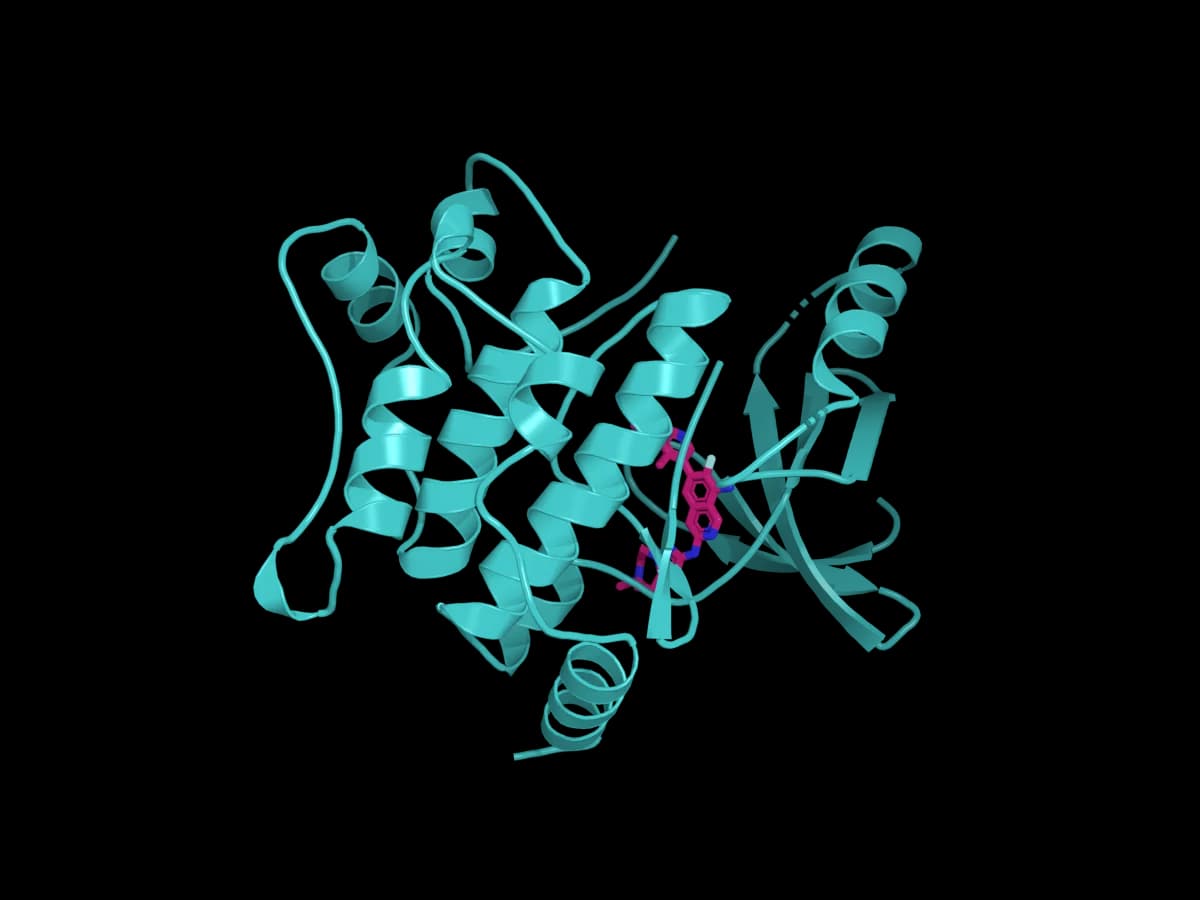
- PDB 8CIJ, ligand USF
- Training data
- TSAP (Boltz-2): 120 compounds, KiTSAP (AI-QSAR): 120 compounds, Ki
- Validation
- Predicted and measured values are compared on compounds held out of training.
- Cost
- From 100 cr, quoted before you submit
- Model version
- TSAP (Boltz-2): TSAP pipeline v2.2TSAP (AI-QSAR): Ridge regression on docking features
Validation results
Predicted and measured values compared on compounds held out of training. RMSE is in log units (pIC50 and similar).
TSAP (Boltz-2)
Pearson r
0.88
R²
0.72
RMSE (log units)
0.60
Holdout compounds
30
TSAP (AI-QSAR)
Pearson r
0.84
Square root of RSQ
RSQ
0.70
Holdout compounds
30
How to use it
Under Predict with this model, press TSAP (Boltz-2) or TSAP (AI-QSAR). The wizard of the workflow you pressed opens with the MAP4K1 model already selected.
Upload the SMILES of the compounds to predict as a .smi, .csv or .txt file.
Check the estimated credits and time, then submit.
The result is a table of compounds ranked by predicted Ki.
Limitations
- Predictions can be less accurate for compounds whose structures differ a lot from the training data.
- Validation used only about 30 compounds, so performance on new compounds can differ from these metrics.
- Predictions do not replace experiments. Use them to decide what to synthesize and measure first.