

Virtual Screening
Dock a compound library to find hit candidatesGive a protein structure and a list of compounds, and each compound is docked into the pocket and scored. You get a ranked table you can filter by score, drug-likeness and chemical family, so you know which compounds to buy before you run an experiment.
GNINA 1.3.1 with CNN rescoring · Doc updated Oct 14, 2026
- Input
- Structure + compounds
- Output
- Poses, scores, clusters
- Engine
- GNINA
- Cost
- 1 cr per compound
- Runs on
- Up to 200 GPUs at once
When to use
- You have a target with a known structure and want first hit candidates
- You want to decide which compounds from a purchasable library to buy first
- You want to shrink a long list before slower steps such as AI-Cofolding or activity prediction
No structure for your target? Predict one with AI-Cofolding first. Docking scores are not measured binding strengths. Use them to rank compounds, not to promise potency.
How it works
- 01Prepare the receptor
Keeps the first model and the chains you chose, removes alternate atom positions (altLoc), water and the bound ligand, and keeps only the ions and cofactors you ticked.
- 02Set the pocket
A docking box is drawn around a reference ligand, from the structure or from a file. You can also give the box center and size yourself.
- 03Dock and rescore
Each compound gets 3D coordinates with RDKit, then GNINA searches poses in the box and a CNN rescores each pose for how plausible it is and how strongly it binds.
- 04Filter and group
Compounds are ranked, drug-likeness properties are computed, and similar structures can be grouped into clusters so you compare chemical families.
Input formats
| Item | Accepted | Notes |
|---|---|---|
| Receptor | PDB ID, or a .pdb, .pdbqt or .cif upload up to 50 MB | Pick the chains to keep. Water is removed automatically |
| A reference ligand (from the structure, or an .sdf, .mol2 or .pdb file), or a box center and size | Manual boxes start at 20 Å per side and can be 1–100 Å | |
| Compounds | Pre-built libraries, or your own .smi, .txt, .csv or .tsv file up to 100 MB | Pre-built: Enamine sets (Hit Locator, Discovery Diversity, PPI, CNS, Covalent, molecular glues) and PharmBricks. Combine up to 20; duplicates are removed |
| Count | Up to 100,000 compounds per job | Compounds with more than 70 rotatable bonds are rejected before you are charged |
Pre-built libraries can be narrowed before docking by molecular weight, cLogP, TPSA, hydrogen bond donors and acceptors, and QED.
Tutorial: dock known EGFR inhibitors into the erlotinib pocket
PDB 1M17 is the kinase domain of EGFR, a lung cancer target, with the drug erlotinib bound (ligand code AQ4). We use erlotinib's site as the pocket and dock 40 EGFR inhibitors with measured potency into it, to see whether docking ranks the potent ones near the top. Run example at the top of this page fills all of this in for you.
Load the structure
In Target Protein, enter
1M17as the PDB ID. The structure appears in the viewer on the right.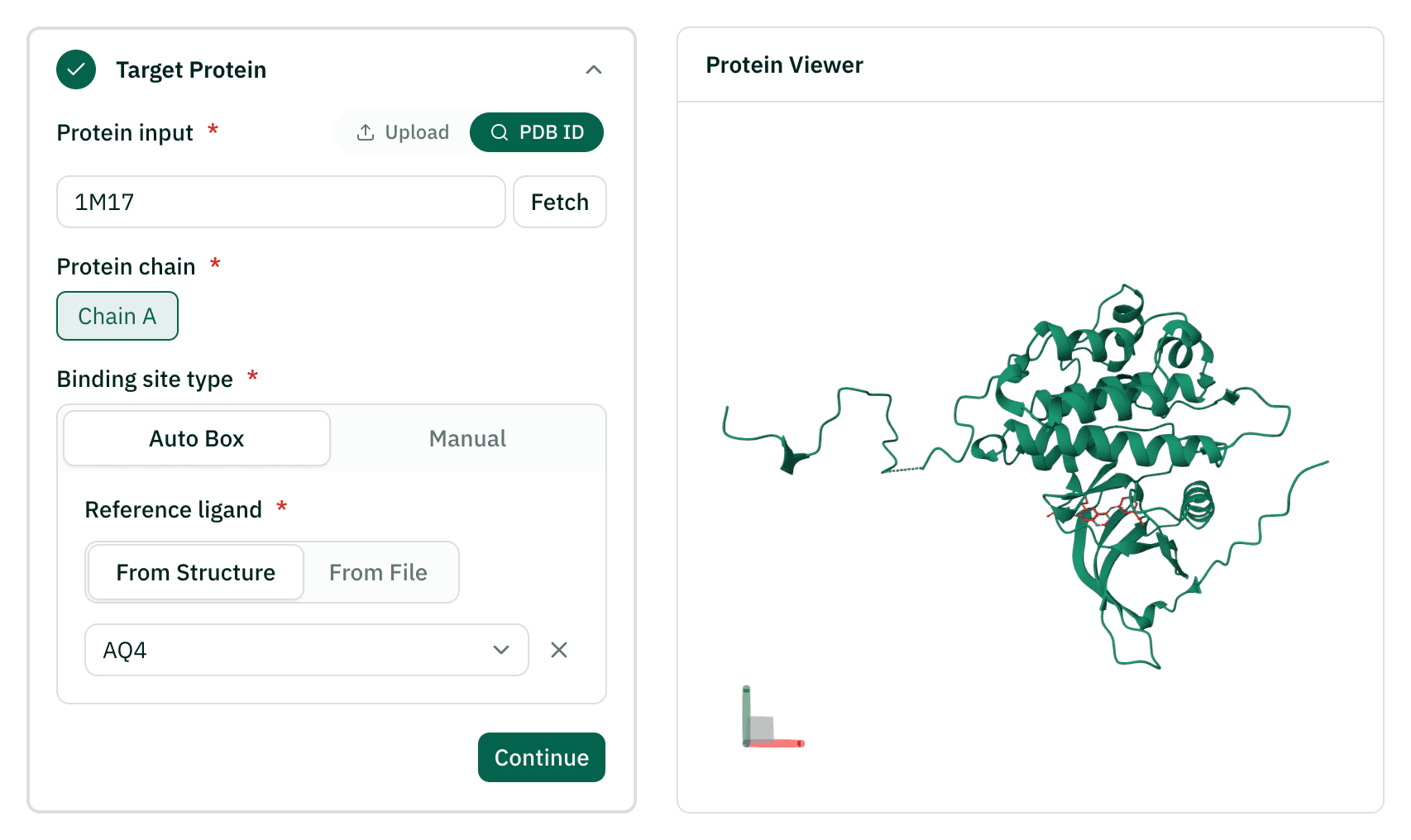
Pick the chain and the pocket
Keep chain A. Under binding site, choose Auto Box and pick
AQ4as the reference ligand. The box is drawn around erlotinib.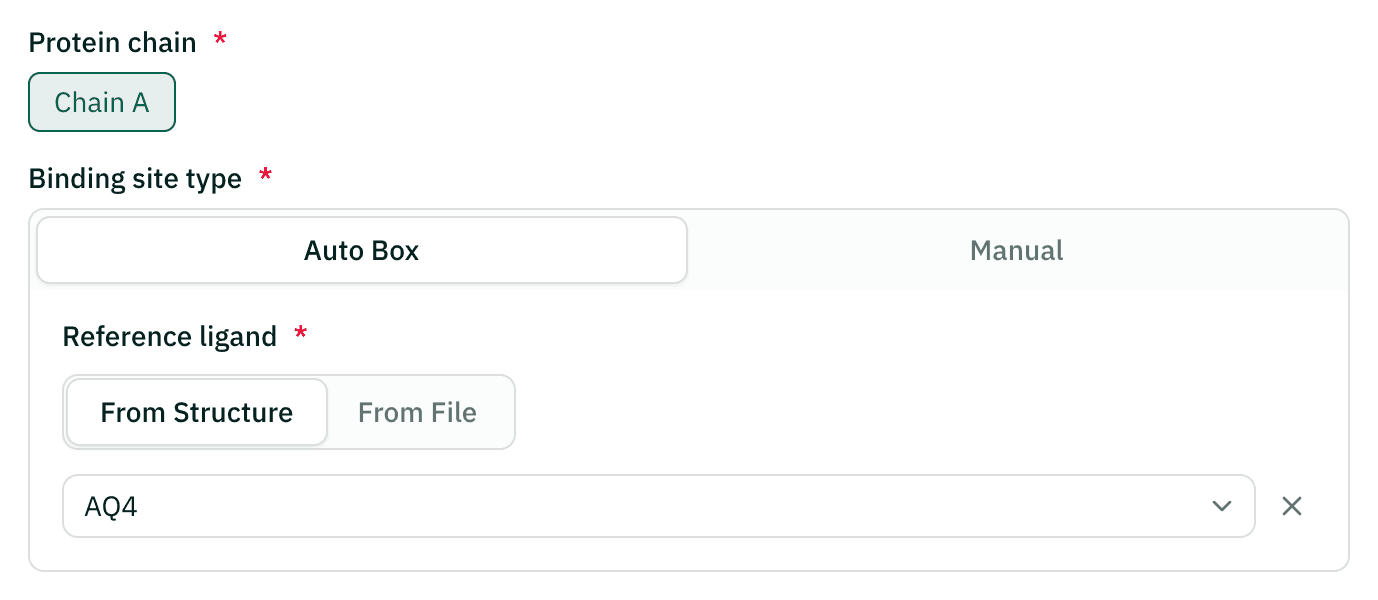
Add the compounds
In Ligand Library, choose Upload and add egfr-example-ligands.txt: 40 EGFR inhibitors from ChEMBL, one ID and SMILES per line. For a real screen, pick a pre-built library instead. The estimated credits update with the compound count.
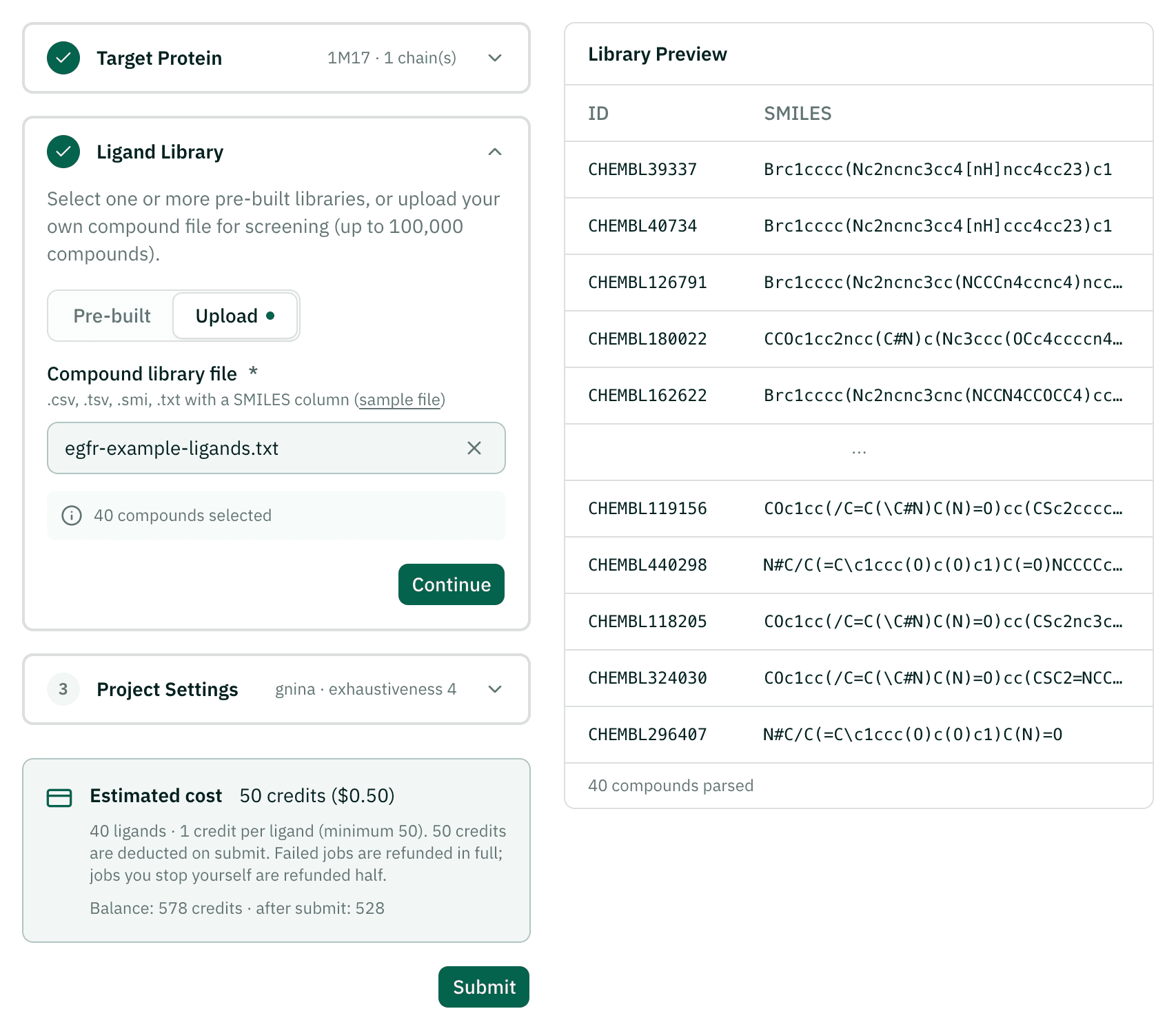
Check and submit
In Project Settings, name the project, check the credits in the summary (40 compounds cost the 50 cr minimum) and submit. We email you when it finishes.
Filter and group the results
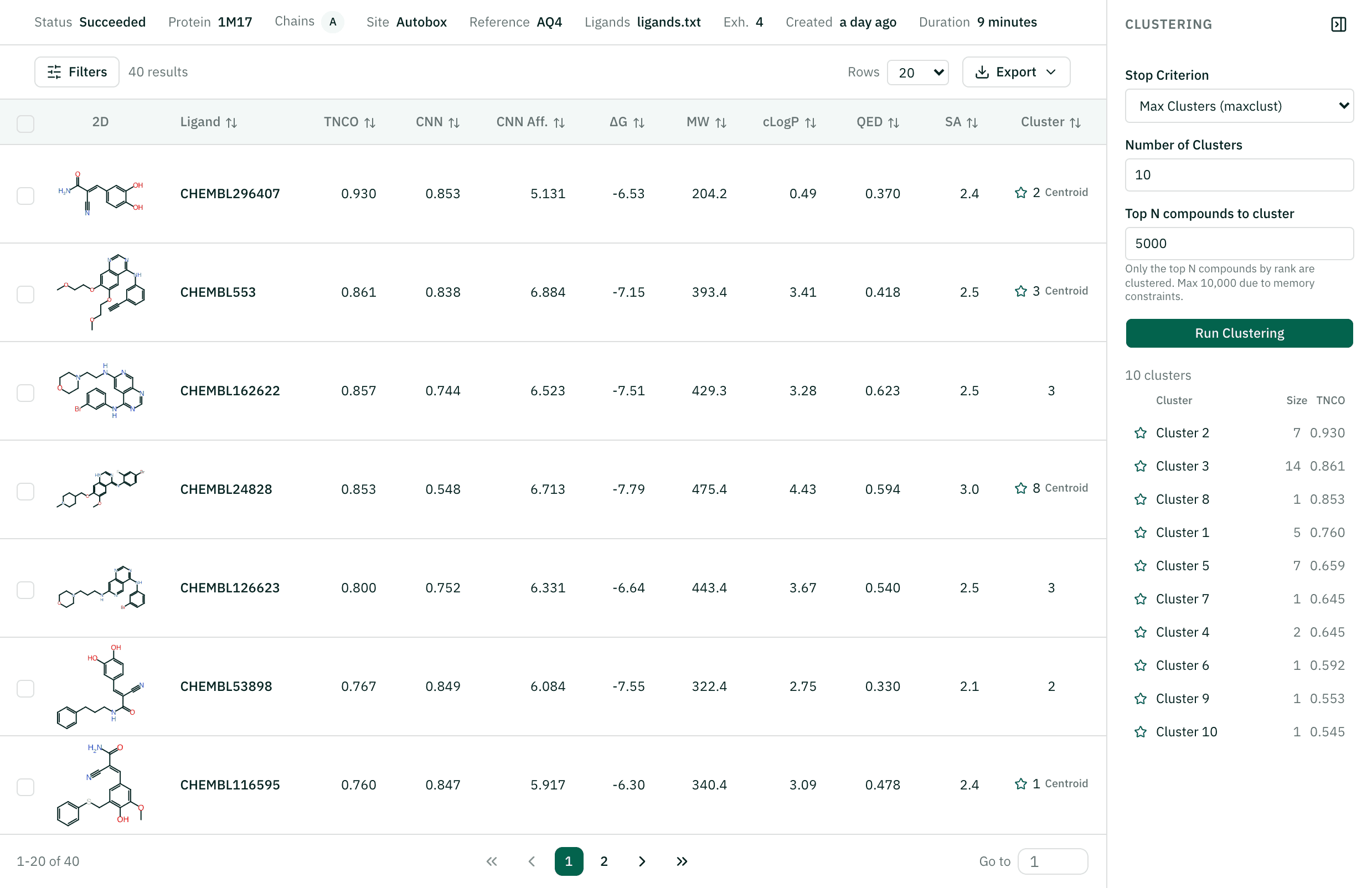
On the result page, apply a filter preset such as Lipinski Ro5, run clustering, and open a compound to see its pose in 3D.
Take it further
Export the compounds you like as CSV or SDF poses, open Enamine compounds in the Enamine store, or fold the best ones with AI-Cofolding.
Reading the results
| Column | Meaning | How to read it |
|---|---|---|
| TNCO | Combined score of CNN affinity, CNN score and ΔG, used to pick each compound's best pose and the default order | Higher is better. It is normalized over one compound's own poses, so also check CNN Aff. and ΔG when comparing compounds |
| CNN | CNN pose score (0–1): how likely the pose is a real binding pose | Higher means a more trustworthy pose |
| CNN Aff. (pKd) | CNN-predicted binding strength | Higher means tighter predicted binding. 1 unit is a tenfold change |
| ΔG (kcal/mol) | Physics-based docking score | Lower (more negative) is better |
| MW, cLogP, QED, SA | Molecular weight, lipophilicity, drug-likeness (0–1) and synthetic accessibility | Use the filter presets (Lipinski, lead-like, fragment, drug-like) |
| Cluster | Group of structurally similar compounds | Look at a few per family. The cluster's top-ranked compound is its representative |
Clustering uses Morgan fingerprints (radius 2, 512 bits) and Tanimoto similarity with average-linkage hierarchical clustering over the top 5,000 compounds by default.
Example result: EGFR 1M17
A real job, shown read-only. Erlotinib itself (CHEMBL553) ranks second of the 40 compounds, and the viewer shows its docked pose in the pocket it occupies in the crystal structure.
| Compound | TNCO | CNN | CNN Aff. | ΔG |
|---|---|---|---|---|
| CHEMBL296407 | 0.930 | 0.853 | 5.13 | -6.5 |
| CHEMBL553 (erlotinib) | 0.861 | 0.838 | 6.88 | -7.2 |
| CHEMBL162622 | 0.857 | 0.744 | 6.52 | -7.5 |
| CHEMBL24828 | 0.853 | 0.548 | 6.71 | -7.8 |
| CHEMBL126623 | 0.800 | 0.752 | 6.33 | -6.6 |
Cost and time
| Compounds | Credits | Price |
|---|---|---|
| 1,000 | 1,000 cr | $10 |
| 10,000 | 10,000 cr | $100 |
| 100,000 | 100,000 cr | $1,000 |
One compound costs 1 cr ($0.01), with a minimum of 50 cr per job. Compounds are split into chunks docked in parallel on up to 200 GPUs, so up to 10,000 compounds run in a single wave and take about as long as a few hundred. The EGFR example (40 compounds) took about 12 minutes of docking once a GPU was assigned. The wizard shows the credits before you submit, and the result page shows the remaining time while it runs.
If the job fails or finishes with no results, the credits come back in full. If you stop it yourself, half comes back.
Citations
If you use these results in a report or paper, please cite the methods below.
- McNutt AT, Francoeur P, Aggarwal R, Masuda T, Meli R, Ragoza M, Sunseri J, Koes DR. GNINA 1.0: molecular docking with deep learning. J Cheminform 13, 43 (2021). doi:10.1186/s13321-021-00522-2Docking and CNN rescoring
- Ragoza M, Hochuli J, Idrobo E, Sunseri J, Koes DR. Protein-ligand scoring with convolutional neural networks. J Chem Inf Model 57, 942-957 (2017). doi:10.1021/acs.jcim.6b00740CNN scoring model
- Trott O, Olson AJ. AutoDock Vina: improving the speed and accuracy of docking with a new scoring function, efficient optimization, and multithreading. J Comput Chem 31, 455-461 (2010). doi:10.1002/jcc.21334Vina scoring function behind ΔG
- RDKit contributors. RDKit: Open-source cheminformatics. Zenodo (2026). doi:10.5281/zenodo.5916373D coordinates, properties and fingerprints
- Rogers D, Hahn M. Extended-connectivity fingerprints. J Chem Inf Model 50, 742-754 (2010). doi:10.1021/ci100050tMorgan (ECFP) fingerprints for clustering
- Stamos J, Sliwkowski MX, Eigenbrot C. Structure of the epidermal growth factor receptor kinase domain alone and in complex with a 4-anilinoquinazoline inhibitor. J Biol Chem 277, 46265-46272 (2002). doi:10.1074/jbc.M207135200EGFR–erlotinib structure used in the tutorial (PDB 1M17)