

Compound Alignment
Score analogs in the pose of a known ligandGive a protein, a ligand whose bound pose you know, and a series of its analogs. Each analog's shared core is laid on the known ligand's core and gnina refines or scores it in the pocket, so you compare the series by what its side groups change, without docking searching for a new pose each time.
GNINA 1.3.1 with RDKit core overlay · Doc updated Oct 22, 2026
- Input
- Structure, reference ligand, compounds
- Output
- Poses, scores, R-group table
- Engine
- GNINA + RDKit
- Cost
- 1 credit per compound, 50 minimum
- Per job
- Up to 1,000 compounds
When to use
- You have a structure with a bound ligand and a series of its analogs, and want to compare them in that same pose
- You are optimizing side groups (lead optimization) and want to see which ones help, position by position
- Docking puts your analogs in poses that look nothing like the known one, and you want the shared part to stay where it is
Alignment assumes each analog binds the way the reference does and only checks that they share a core. When the compounds do not share a core with a known ligand (screening a library, a new scaffold), when there is no bound ligand to start from, or when the analogs may bind differently, use Molecular Docking (Virtual Screening), which searches the pocket for each pose.
How it works
- 01Check the core
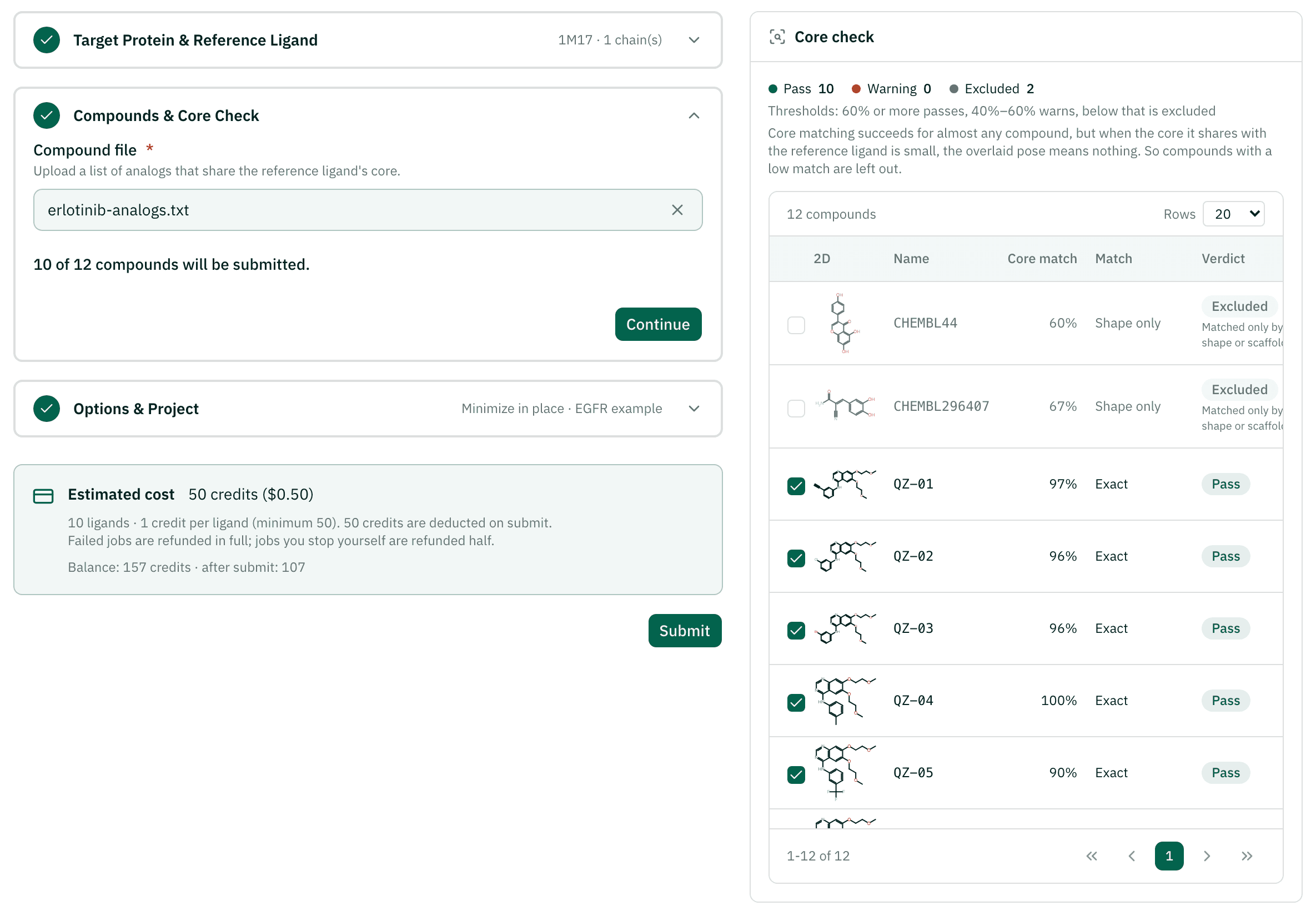
For each compound, RDKit finds the largest structure it shares with the reference ligand (the maximum common substructure, MCS), trying the strict match first: same elements and bonds, then same elements only, then shape only. The share of the compound's atoms inside that common part is its core match. 60% or more passes, 40% to 60% warns, and anything lower, or matched by shape only, is excluded. The check is free and runs before you submit.
- 02Overlay on the reference
RDKit builds 10 3D shapes (conformers) of each compound and lays each one so that its core atoms sit on the reference's core atoms, the way a tracing is laid over a drawing. The side groups that differ point wherever the conformer puts them.
- 03Minimize or score
gnina takes each overlaid conformer in the pocket. Minimize in place lets the pose relax a little where it sits; Score only scores it as it is. A CNN rescores every pose, and the best of a compound's 10 is kept, picked the same way as in docking.
- 04Read by R group
The result table adds RMSD and core match to the docking scores. The R-group table puts the positions of the core that changed across the series (R1, R2...) on its axes and fills each cell with a score.
Input formats
| Item | Accepted | Notes |
|---|---|---|
| Receptor | PDB ID, or a .pdb, .pdbqt or .cif upload up to 50 MB | Pick the chains to keep. Water is removed automatically |
| Reference ligand | A ligand in the structure, or an .sdf, .mol2 or .pdb file | Required: it sets both the pocket and the pose. An uploaded file needs 3D coordinates in the same frame as the structure; if it holds several molecules, the first one is used |
| Compounds | Your own .smi, .txt, .csv or .tsv file up to 5 MB | Analogs of the reference. The ID and SMILES columns are found as in docking. Salts and solvents are stripped and the largest piece is aligned |
| Count | Up to 1,000 compounds per job | Compounds with more than 70 rotatable bonds are rejected before you are charged |
| Mode | Minimize in place (the default) or Score only | Both cost the same |
The pre-built screening libraries are not offered here: their compounds do not share a core with your reference. The check runs as soon as the structure, the reference and the compound file are all in place, and the server runs it again when you submit, so excluded compounds never reach the job.
Tutorial: erlotinib analogs in EGFR
Erlotinib is a lung cancer drug that blocks EGFR, a kinase. In the crystal structure 1M17 it sits in the pocket where ATP normally binds, with its quinazoline (two fused six-membered rings) deep in the pocket and its aniline ring (a benzene ring on an NH) pointing into a side pocket. The example keeps erlotinib's quinazoline and its two methoxyethoxy chains and changes only the aniline ring: five groups at its 3-position, each with and without a fluorine at its 4-position. QZ-01 is erlotinib itself, the starting point of the series. Two compounds from another chemical family are mixed in to show what the check leaves out. Run example at the top of the page fills in everything below.
| Compounds | 3-position of the aniline | 4-position of the aniline |
|---|---|---|
| QZ-01 to QZ-05 | ethynyl, chloro, bromo, methyl, trifluoromethyl | H |
| QZ-06 to QZ-10 | ethynyl, chloro, bromo, methyl, trifluoromethyl | F |
| CHEMBL44 | Another family: genistein, an isoflavone | Not a quinazoline, so it has no aniline |
| CHEMBL296407 | Another family: a tyrphostin | Not a quinazoline, so it has no aniline |
Pick the structure and the reference
In Target Protein & Reference Ligand, enter the PDB ID 1M17, keep chain A and choose AQ4 (erlotinib) as the reference ligand. Its pose is where every compound will be laid.
Upload the compounds
In Compounds & Core Check, upload the compound file. The check starts at once and its table appears on the right.
Read the check
The ten analogs pass with a core match between 88% and 100%, all matched Exact. Genistein and the tyrphostin are excluded with "Matched only by shape or scaffold": their rings line up with erlotinib's only when the elements are ignored, so laying them on its pose would mean nothing. Genistein's core match is 60%, enough to pass on the number alone, which is why a shape-only match is excluded whatever its number. A compound with a warning would get a checkbox here, so you decide whether it goes in.
Pick the mode and submit
In Options & Project, keep Minimize in place, name the project and submit. Ten compounds go in, so the quote is the 50 credit minimum.
Read the results
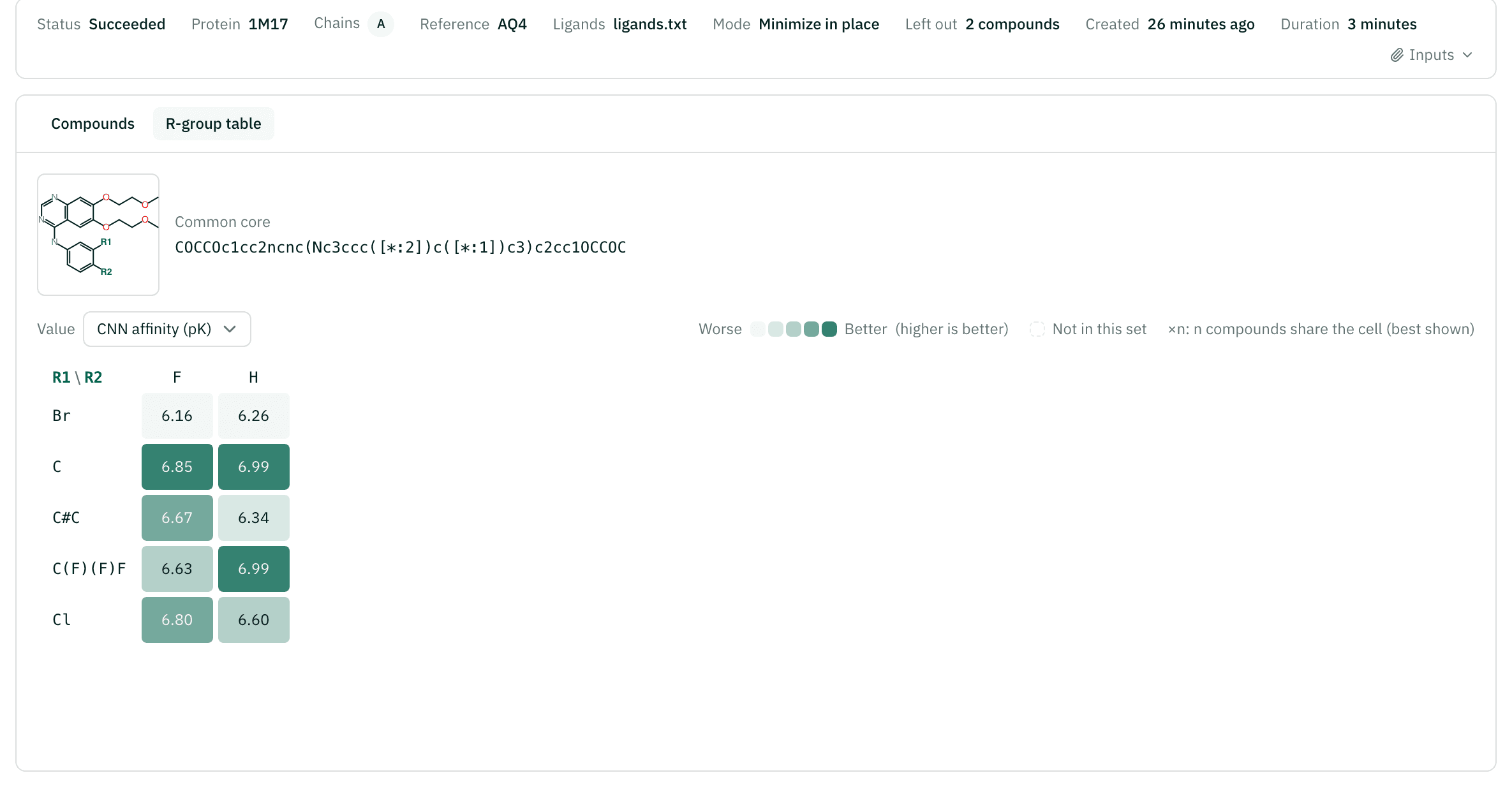
The compound table opens sorted by CNN affinity, with RMSD and core match next to the scores. Switch to R-group table to see the five 3-position groups (R1) against the 4-position fluorine or hydrogen (R2), and pick which score fills the cells.
Carry on
Download the table, or take the analogs worth making to a target model to predict their activity.
Reading the results
| Column | Meaning | How to read it |
|---|---|---|
| TNCO | Combined score of CNN affinity, CNN score and ΔG, used to pick each compound's best pose | Higher is better. It is normalized over one compound's own poses, so compare compounds with CNN Aff. and ΔG |
| CNN | CNN pose score (0–1): how likely the pose is a real binding pose | Higher means a more trustworthy pose |
| CNN Aff. (pKd) | CNN-predicted binding strength | Higher means tighter predicted binding. 1 unit is a tenfold change. The table opens sorted by it |
| ΔG (kcal/mol) | Physics-based score | Lower (more negative) is better |
| RMSD (Å) | How far the compound's core atoms sit from the reference's core atoms, on average | Lower means the core stayed on the known pose. Around 2 Å, the usual line for "the same pose" in docking, the compound has drifted and its score compares less well with the rest |
| Core match (%) | Share of the compound's atoms (hydrogens aside) inside the core it shares with the reference | The check's number. The lower it is, the more of the compound hangs outside the part that pins it in place |
| MW, cLogP, QED, SA | Molecular weight, lipophilicity, drug-likeness (0–1) and synthetic accessibility | The same filters as docking |
The R-group table finds the core the results share and numbers only the positions that changed: the one with the most different groups is R1, the next R2, and positions that are the same in every compound get no number. Pick the score that fills the cells (CNN affinity, CNN score, binding energy or RMSD) and which positions go on the rows and the columns. Cells are shaded from worse to better; when several compounds land in one cell, the best value is shown with ×n, and a combination missing from your set is left blank so you can see what has not been made yet. A note under the table counts the compounds that do not fit the core; they stay in the compound table.
Example result: erlotinib analogs in EGFR 1M17
A real job, shown read-only: the analogs with the highest CNN affinity, and the top one's pose laid over erlotinib in the pocket.
| Compound | R1 | R2 | CNN Aff. | ΔG | RMSD | Core match (%) |
|---|---|---|---|---|---|---|
| QZ-05 | C(F)(F)F | H | 6.99 | -7.1 | 1.32 | 90 |
| QZ-04 | C | H | 6.99 | -7.0 | 1.18 | 100 |
| QZ-09 | C | F | 6.85 | -6.7 | 1.41 | 97 |
| QZ-07 | Cl | F | 6.80 | -6.7 | 1.72 | 93 |
| QZ-06 | C#C | F | 6.67 | -6.2 | 1.87 | 93 |
Cost and limits
| Compounds submitted | Credits | Price |
|---|---|---|
| 10 | 50 credits | $0.50 |
| 200 | 200 credits | $2 |
| 1,000 | 1,000 credits | $10 |
A submitted compound costs 1 credit ($0.01), with a minimum of 50 credits per job, the same price as Molecular Docking. Both modes cost the same. The core check is free, and the quote counts only the compounds that will be submitted: excluded ones and warnings you uncheck cost nothing. The wizard shows the quote before you submit and that is what is deducted. The example submits 10 compounds and costs 50 credits.
A job takes up to 1,000 compounds in a file of up to 5 MB, and the check takes the same. You can run the check up to 20 times a minute. Because nothing is searched, alignment computes several times faster than docking the same compounds.
If the job fails or finishes with no results, the credits come back in full. If you stop it yourself, half comes back.
Citations
When you use results from this workflow in a report or paper, please cite the methods below.
- McNutt AT, Francoeur P, Aggarwal R, Masuda T, Meli R, Ragoza M, Sunseri J, Koes DR. GNINA 1.0: molecular docking with deep learning. J Cheminform 13, 43 (2021). doi:10.1186/s13321-021-00522-2Minimizing and scoring the overlaid poses, and CNN rescoring
- Ragoza M, Hochuli J, Idrobo E, Sunseri J, Koes DR. Protein-ligand scoring with convolutional neural networks. J Chem Inf Model 57, 942-957 (2017). doi:10.1021/acs.jcim.6b00740CNN scoring model
- Trott O, Olson AJ. AutoDock Vina: improving the speed and accuracy of docking with a new scoring function, efficient optimization, and multithreading. J Comput Chem 31, 455-461 (2010). doi:10.1002/jcc.21334Vina scoring function behind ΔG
- RDKit contributors. RDKit: Open-source cheminformatics. Zenodo (2026). doi:10.5281/zenodo.591637Core matching, conformers, overlay, R groups and properties
- Dalke A, Hastings J. FMCS: a novel algorithm for the multiple MCS problem. J Cheminform 5, O6 (2013). doi:10.1186/1758-2946-5-S1-O6Maximum common substructure (MCS) search
- Bemis GW, Murcko MA. The properties of known drugs. 1. Molecular frameworks. J Med Chem 39, 2887-2893 (1996). doi:10.1021/jm9602928Murcko scaffolds, used when no core is found otherwise
- Stamos J, Sliwkowski MX, Eigenbrot C. Structure of the epidermal growth factor receptor kinase domain alone and in complex with a 4-anilinoquinazoline inhibitor. J Biol Chem 277, 46265-46272 (2002). doi:10.1074/jbc.M207135200EGFR–erlotinib structure used in the tutorial (PDB 1M17)
FAQ
Run the Compound Alignment workflow yourself
Sign up and get 500 credits. No card required. You can also choose to get news about new models and workflows.